
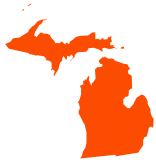
Michigan

Michigan has achieved all six pillars of rape kit reform. The state has cleared its backlog.

Reform Status
Full Reform
Testing Status
In-Process

Pillar Count

6/6 Pillars
Michigan has achieved all six pillars of rape kit reform. The state is working on clearing its backlog.
Statewide Inventory

Yes, the state has a recurring inventory.

  • Is the inventory recurring? Yes
  • Are law enforcement agencies and/or labs required to participate in the inventory? Yes
  • Does the law require to document the date of when each kit was collected? No
  • Does the law require a reason to be given as to why the kit was not submitted to a crime lab for testing? No
  • Does the law require untested kits to be counted? Yes
Test Backlogged Kits

In-Process, the state has committed to testing its backlogged kits.

Michigan has eliminated its backlog through non-legislative means.

Test New Kits

Yes, all newly collected kits are being tested.

  • According to the law, how much time after a rape kit examination do hospitals have to notify law enforcement that a kit is ready to be picked up? 24 Hours
  • According to the law, after being notified, within what time frame is law enforcement required to pick up the kit? 14 Days
  • According to the law, after picking the kit up, within what time frame is law enforcement required to submit the kit to the lab? 14 Days
  • According to the law, after receiving the kit, within what time frame is the lab required to test the kit? 90 Days
  • Does the law allow crime labs to outsource kits for testing if they are unable to meet the deadline? Not specified
Implement Tracking System

Yes, tracking system in use.

  • Does the law state that the tracking system should track initial collection at hospital, inventory and storage by law enforcement, and testing and storage by state labs? No
  • Does the law state that the tracking system should track if kit a has been destroyed? No
  • Does the law allow all agencies who participate in the tracking system to update the status of a kit? No
  • Does the law state that the tracking system should have a victim portal? Yes
  • Does the law require law enforcement, labs, and hospitals to participate in the tracking system? No
  • Does the law state that all previously untested kits should be entered into the system? No
Victim's Right To Know

Yes, the state has granted victims the right to notice and be informed on the status of their kit.

  • Do victims have the right to receive information of the location, testing date, and testing results of their kit? Yes
  • Do victims have the right to be informed when there is any change in the status of their case? Yes
  • Do victims have the right to receive notification before destruction of their kit? No
  • Are victims granted further preservation of the kit or its probative contents? No
  • Are victims provided with the contact information for the designated liaison(s) at the corresponding law enforcement agency at the time that a kit is collected? Yes
  • Do victims have the right to receive a physical document identifying their rights under law? Yes
Fund Reform

Yes, the state has allocated ongoing funding.

See state reform timeline below.

Take Action Today to Bring Further Rape Kit Reform to Michigan

State Reform Timeline

2024
Inventory
Michigan backlog at 648 kits

According to a report from the Michigan State Police Crime Lab, there were 648 untested kits at the end of fiscal year 2024.

2023
Inventory
Michigan backlog at 320 kits

According to a report from the Michigan Department of State Police, there were 320 untested kits at the end of fiscal year 2023.

Funding
$1,500,000 awarded to the Michigan Department of State Police

In 2023, the U.S. Department of Justice Bureau of Justice Assistance (BJA) awarded the Michigan Department of State Police $1,500,000 to investigate cases related to sexual assault kits and provide a victim-centered, statewide response to sexual assault.

2022
Funding
$4 million awarded in Michigan

In 2022, BJA awarded Wayne County $1.5 million to investigate and prosecute cold case sexual assaults, and the City of Flint Police Department $2.5 million to to enhance and expand their SAK inventory tracking system, Forensic Genetic Genealogy (FGG) testing, an FGG tracking system, and funding personnel for investigation and final adjudication.

Inventory
Michigan backlog at 397 kits

According to a report from the Michigan Department of State Police. There were 397 untested kits at the end of fiscal year 2022.

Bill: Enacted
HB5783 enacted in Michigan

In 2022, the Michigan governor signed HB5783, appropriating $1,459,500 to law enforcement to to test backlogged kits; and $369,500 for the statewide sexual assault evidence kit tracking system for fiscal year 2022-2023.

Bill: Failed
HB4373 / SB187 failed in Michigan

In 2022, Michigan legislators introduced HB4373 / SB187, a bill that would allocate $800,000 for the sexual assault kit tracking system. This bill failed to pass.

2021
Funding
$1 million awarded in Wayne County

In 2021, BJA awarded Wayne County $1 million to investigate and prosecute cold case sexual assaults.

2020
Bill: Enacted
HB5396 enacted in Michigan

In 2020, the Michigan governor signed HB5396, a bill appropriating $1,459,500 to law enforcement to eliminate all rape kit backlogs across this state; to assist local prosecutors with investigations and prosecutions of viable cases; and to provide victim services. The bill also required the Department of the Attorney General to provide a report on the number of backlogged kits, and an action plan to end it.

Funding
$999,755 awarded in Wayne County

In 2020, BJA awarded Wayne County $999,755 to investigate and prosecute cold case sexual assaults.

Bill: Failed
SB1194 failed in Michigan

In October 2020, Michigan legislators introduced SB1194, a bill that would have improved kit handling and testing timelines, mandating law enforcement to pick up a kit from a health care facility within seven days and submit it to the lab within seven days, instead of 14 days for each. Under this bill, labs would have been required to test kits within 30 days, instead of 90. Legislators also introduced SB1193 and SB1195, bills that would have extended the kit retention period and required a second written notice to survivors before the disposal of unreported kits. These bills failed to pass.

2019
Non-Legislative Reform
Michigan State Police instated rape kit tracking system

In 2019, Michigan State Police rolled out the state’s rape kit tracking system. With the development of a new statewide tracking system for rape kits, Michigan has enacted all six pillars of comprehensive rape kit reform.

Funding
$2,650,361 awarded in Michigan

In 2019, BJA awarded the City of Flint Police Department and the Wayne County Prosecutor’s Office $1,650,361 and $1 million respectively to sustain their work on rape kit reform.

Other
Michigan's tracking system goes live

In 2019, Michigan’s tracking system went live.

2018
Funding
Over $3 million awarded in Michigan

In 2018, BJA awarded the Michigan Department of State Police $1 million and Wayne County $1.5 million to sustain their work. BJA awarded the Michigan Department of State Police an additional $633,907 to aid with the investigation and prosecution of cold case sexual assaults.

2017
Funding
$4 million appropriated in Michigan

In 2017, Michigan legislators appropriated $4 million in state budget funds to support creation of a statewide, electronic tracking system for rape kits. Of that, $800,000 was to be used for immediate implementation.

Inventory
1,177 kits found in Michigan

The Michigan State Police reported 1,177 untested rape kits at the beginning of Fiscal Year 2017.

Funding
$1.5 million awarded in Michigan

In 2017, the Wayne County Prosecuting Attorney’s Office received $1.5 million from BJA to investigate and prosecute cases and re-engage survivors.

2016
Funding
Nearly $2 million additional funding awarded in Michigan

In 2016, BJA awarded the Michigan Department of State Police $999,979 and the City of Flint Police Department $996,243 to aid with the investigation and prosecution of cold case sexual assaults, totaling $1,996,222 in grants.

Bill: Enacted
HB5294 signed into law

In 2016, the Michigan Governor signed HB5294. This bill calls for recurring annual inventories of untested rape kits.

2015
Funding
$1,329,999 awarded in Flint

In 2015, the Manhattan District Attorney’s Office and the U.S. Department of Justice Bureau of Justice Assistance (BJA) awarded the City of Flint Police Department a total of $1,329,999 to test kits, investigate and prosecute cases, and re-engage survivors.

Funding
Over $5 million awarded in Michigan

Also in 2015, the Michigan State Police received $3,381,991 from both the Manhattan District Attorney’s Office and BJA. The Wayne County Prosecuting Attorney’s Office received $1,999,109 from BJA to investigate and prosecute cases and re-engage survivors.

2014
Bill: Enacted
SB998 enacted in Michigan

In 2014, Michigan enacted SB998, convening a commission to develop a plan for implementation of a statewide tracking system. In December 2018, Governor Rick Snyder announced the new statewide rape kit tracking system, Track-Kit. Allegan, Barry, Berrien, Branch, Cass, Kalamazoo, St. Joseph, and Van Buren counties had access to the system, and the rest of state was to have access by summer 2019. Kits collected before the implementation of the system would not be accessible. With the development of a rape kit tracking system, Michigan has enacted all six pillars of legislative rape kit reform.

Bill: Enacted
HB5445 enacted in Michigan

In 2014, Michigan enacted HB5445, requiring law enforcement to collect rape kits from the hospital within 14 days and to send kits for testing within 14 days of taking possession of them. The law requires the lab to analyze rape kits within 90 days, if sufficient resources are available.

Bill: Enacted
Act 319 enacted in Michigan

In 2014, the state enacted Act 319, a law granting survivors the right to receive information about the status and location of their rape kits.

2013
Funding
$7 million appropriated in Michigan

In 2013, Michigan legislators appropriated $4 million in new funding to test backlogged kits. In 2014, Michigan legislators appropriated an additional $3 million to fund prosecutions linked to newly tested kits from the backlog.

2009
Inventory
11,341 kits found in Wayne County

In 2009, the Wayne County Prosecutor’s Office discovered 11,341 untested kits. As of June 2021, Detroit had tested all 11,341 kits and ended its known backlog, resulting in over 3,100 DNA matches, the identification of more than 840 serial sexual offenders, and over 250 convictions. DNA from the tested kits has been linked to crimes committed in 40 states and Washington, D.C.

We haven’t filed an Accountability FOIA in this state ⏤ yet.

Want to advocate for accountability in your state?