
North Carolina

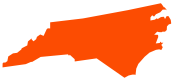
North Carolina is one pillar away from achieving comprehensive rape kit reform. To achieve this, the state needs to grant victims the right to know the status of their kits. The state has eliminated its backlog of untested kits.

Reform Status
Some Reform
Testing Status
Complete

Pillar Count

5/6 Pillars
North Carolina is one pillar away from achieving comprehensive rape kit reform. To achieve this, the state needs to grant victims the right to know the status of their kits. The state has eliminated its backlog of untested kits.
Statewide Inventory

Yes, the state has a recurring inventory.

  • Is the inventory recurring? Yes
  • Are law enforcement agencies and/or labs required to participate in the inventory? Yes
  • Does the law require to document the date of when each kit was collected? No
  • Does the law require a reason to be given as to why the kit was not submitted to a crime lab for testing? No
  • Does the law require untested kits to be counted? Yes
Test Backlogged Kits

Yes, the state has eliminated its backlog.

  • Does the law require law enforcement to submit all untested kits, including those past the statute of limitation, within a certain deadline? No
  • Does the law set a deadline for the crime laboratory to complete analysis once a kit has been submitted to the lab? No
  • Does the law require kits past the statute of limitations to be sent in for testing? No
  • Does the law allow public crime labs to outsource unsubmitted kits? Yes
Test New Kits

Yes, all newly collected kits are being tested.

  • According to the law, how much time after a rape kit examination do hospitals have to notify law enforcement that a kit is ready to be picked up? 24 Hours
  • According to the law, after being notified, within what time frame is law enforcement required to pick up the kit? 7 Days
  • According to the law, after picking the kit up, within what time frame is law enforcement required to submit the kit to the lab? 45 Days
  • According to the law, after receiving the kit, within what time frame is the lab required to test the kit? Not specified
  • Does the law allow crime labs to outsource kits for testing if they are unable to meet the deadline? Not specified
Implement Tracking System

Yes, tracking system in use.

  • Does the law state that the tracking system should track initial collection at hospital, inventory and storage by law enforcement, and testing and storage by state labs? Yes
  • Does the law state that the tracking system should track if kit a has been destroyed? No
  • Does the law allow all agencies who participate in the tracking system to update the status of a kit? Yes
  • Does the law state that the tracking system should have a victim portal? Yes
  • Does the law require law enforcement, labs, and hospitals to participate in the tracking system? Yes
  • Does the law state that all previously untested kits should be entered into the system? Yes
Victim's Right To Know

No, the state has not granted victims the right to notice and be informed on the status of their kit.

  • Do victims have the right to receive information of the location, testing date, and testing results of their kit? n/a
  • Do victims have the right to be informed when there is any change in the status of their case? n/a
  • Do victims have the right to receive notification before destruction of their kit? n/a
  • Are victims granted further preservation of the kit or its probative contents? n/a
  • Are victims provided with the contact information for the designated liaison(s) at the corresponding law enforcement agency at the time that a kit is collected? n/a
  • Do victims have the right to receive a physical document identifying their rights under law? n/a
Fund Reform

Yes, the state has allocated one-time funding.

See state reform timeline below.

Take Action Today to Bring Further Rape Kit Reform to North Carolina

State Reform Timeline

2025
Bill: Committee
HB367 and HB771 introduced in North Carolina

In 2025, legislators in North Carolina introduced HB367 and HB771, two bills that would grant victims the right to know the status of their kits and require notification if a decision is made not to test or to destroy the kit.

2024
Funding
$1 million awarded in Fayetteville

In 2024, the U.S. Department of Justice Bureau of Justice Assistance (BJA) awarded the City of Fayetteville Police Department $1 million to continue its Cold Case Sexual Assault Unit’s work by investigating previously unsolved cases.

Report
North Carolina eliminated their backlog of untested rape kits

In 2024, Attorney General Josh Stein announced that North Carolina has ended its backlog of untested sexual assault kits. The Department of Justice had discovered more than 16,000 untested kits in a statewide inventory in 2019.

As of April 2024, 11,841 kits have been tested or are in the process of being tested. From those kits, 5,075 samples have been entered into the CODIS DNA database, and CODIS has matched the samples to 2,702 kits. 2,024 of those samples had hits to offenders whose DNA is in the database due to previous convictions or arrests. Law enforcement has made 114 arrests based on those hits.

2023
Funding
$1,150,000 awarded in Durham County

In 2023, the U.S. Department of Justice Bureau of Justice Assistance (BJA) awarded Durham County $1,150,000 to expand prosecution of cold case sexual assaults.

Funding
$900,000 awarded in Charlotte

In 2023, the U.S. Department of Justice Bureau of Justice Assistance (BJA) awarded the $900,000 to the Charlotte-Mecklenburg Police Department (CMPD) to support its Lawfully Owed DNA Collection Initiative.

Funding
Second grant, for $2,000,000, awarded in Charlotte

In 2023, the U.S. Department of Justice Bureau of Justice Assistance (BJA) awarded a second grant the Charlotte-Mecklenburg Police Department (CMPD) for $2,000,000. This money will be used to increase and improve lab capacity.

Inventory
1433 untested kits left in North Carolina

In August 2023, the North Carolina Attorney General announced that there were 1433 untested kits left in the state.

Inventory
1800 untested kits left in North Carolina

In January 2023, the North Carolina Attorney General announced that there are about 1800 untested kits left in the state.

2022
Funding
$2.5 million awarded in North Carolina

In 2022, BJA awarded the city of Charlotte $2.5 million to sustain its rape kit work.

Inventory
3,053 untested kits in North Carolina

According to North Carolina Department of Justice’s crime lab dashboard, there were 3,053 untested kits in the state in 2022.

2020
Funding
$2,106,558 awarded in North Carolina

In 2020, BJA awarded the city of Charlotte, the city of Durham, and the city of Fayetteville $587,891; $518,667; and $1 million respectively to investigate and prosecute cold case sexual assaults.

2019
Bill: Enacted
HB29 enacted in North Carolina

In 2019, The Survivor Act (HB29) was passed in North Carolina. This law stated that for rape kits collected after July 1, 2019, the medical facility or other agency that collected the rape kit is to notify law enforcement within 24 hours of collection. It then mandates law enforcement to pick up the kit within seven days and submit it to the lab within 45 days. For kits collected before January 1, 2018, law enforcement agencies were required to establish review teams to survey every backlogged kit and determine a testing priority, considering several factors. The Survivor Act prohibits the testing of unreported sexual assault kits, as well as kits connected to cases deemed to be “unfounded” by law enforcement and the review team. The state crime lab is required to test kits “as soon as practicable,” and any law enforcement agency that receives an actionable Combined DNA Index System (CODIS) hit from the lab must report to the lab any arrest or conviction in connection with that hit. HB29 required the North Carolina Department of Justice, the state sexual assault coalition, and other stakeholders to create sexual assault training and response programs. Lastly, the bill appropriated $3 million for the 2019-2020 fiscal year, and another $3 million for the 2020-2021 fiscal year, to assist with the testing of untested rape kits.

Funding
$2,494,054 awarded in North Carolina

In 2019, BJA awarded the city of Charlotte and the city of Durham $1,494,054 and $1 million respectively to sustain their work on rape kit reform.

2018
Bill: Enacted
HB945 enacted in North Carolina

In 2018, North Carolina legislators enacted HB945, requiring the state crime lab to develop a rape kit tracking system that would include all newly collected kits as well as the more than 15,000 untested kits identified in the February 2018 inventory report. The law requires all medical providers, law enforcement agencies, and forensic labs to participate in the system, which must allow survivors access to their kit information. Beginning October 2019, the state lab was to report to the state legislature annually on the number of tracking-enabled kits used for evidence collection, how many of those kits were connected with a reported sexual assault, and how many were submitted to a lab for testing.

Inventory
15,160 kits found in North Carolina

In February 2018, the state crime laboratory reported finding 15,160 untested rape kits in law enforcement custody across North Carolina.

Funding
$2,452,637 awarded in North Carolina

In 2018, BJA awarded the North Carolina Department of Justice $2 million to test kits, investigate and prosecute cases, and re-engage survivors in the criminal justice system. BJA also awarded the city of Charlotte $452,637 to collect lawfully owed DNA from convicted offenders.

Other
North Carolina's tracking system goes live

In October 2018, The North Carolina Attorney General announced that the state’s rape kit tracking system with a victim portal went live.

2017
Inventory
Inventory began in North Carolina

In 2017, legislators included a provision in the state budget requiring a one-time, statewide inventory of untested rape kits in the custody of law enforcement agencies.

Accountability
Accountability Project issued records requests throughout North Carolina

In 2017, we issued records requests to uncover backlogs in Greensboro, Jacksonville, Winston-Salem, and Raleigh. We did not receive complete responses to our requests from any of these cities.

Funding
$837,342 awarded in North Carolina

In 2017, BJA awarded the city of Charlotte $837,342 to process an additional 600 kits and sustain its work on rape kit reform.

2016
Funding
$2,138,474 awarded in North Carolina

In 2016, BJA awarded several new grants in North Carolina. The city of Charlotte was awarded $1,125,606 to process 300 unsubmitted rape kits, investigate and prosecute cases, and re-engage survivors. The City of Greenville Police Department was awarded $219,496 to process 312 unsubmitted rape kits, investigate and prosecute cases, and re-engage survivors. The City of Fayetteville was awarded an additional $793,372 to sustain its work on rape kit reform.

2015
Accountability
2,686 kits found in Durham

In 2015, we issued open records requests to Durham and Raleigh. Our efforts revealed that the Durham Police Department had 2,686 rape kits in inventory as of December 2015. The agency did not know how many of these kits remained untested at the time.

Funding
$921,064 awarded in North Carolina

In 2015, the U.S. Department of Justice Bureau of Justice Assistance (BJA) awarded the city of Fayetteville $363,090 to test kits, investigate and prosecute cases, and re-engage survivors. Also in 2015, the Manhattan District Attorney’s Office awarded the Charlotte-Mecklenburg Police Department $557,974 to test 885 rape kits.

2014
Accountability
1,019 kits found in Charlotte

In 2014, The Accountability Project issued an open records request to bring the number of untested rape kits in Charlotte to light. Through this request, we uncovered a backlog of 1,019 untested rape kits in Charlotte.

Accountability

We have issued public records requests, through the Freedom of Information Act, to the following jurisdictions in North Carolina to discover whether they possess any untested rape kits.
Target
Request Year
Untested kits discovered
Information received
2014
1019
Incomplete information received
2015
1711
2017
1339
Request Denied
2017
944
2017
32
2017
1428
